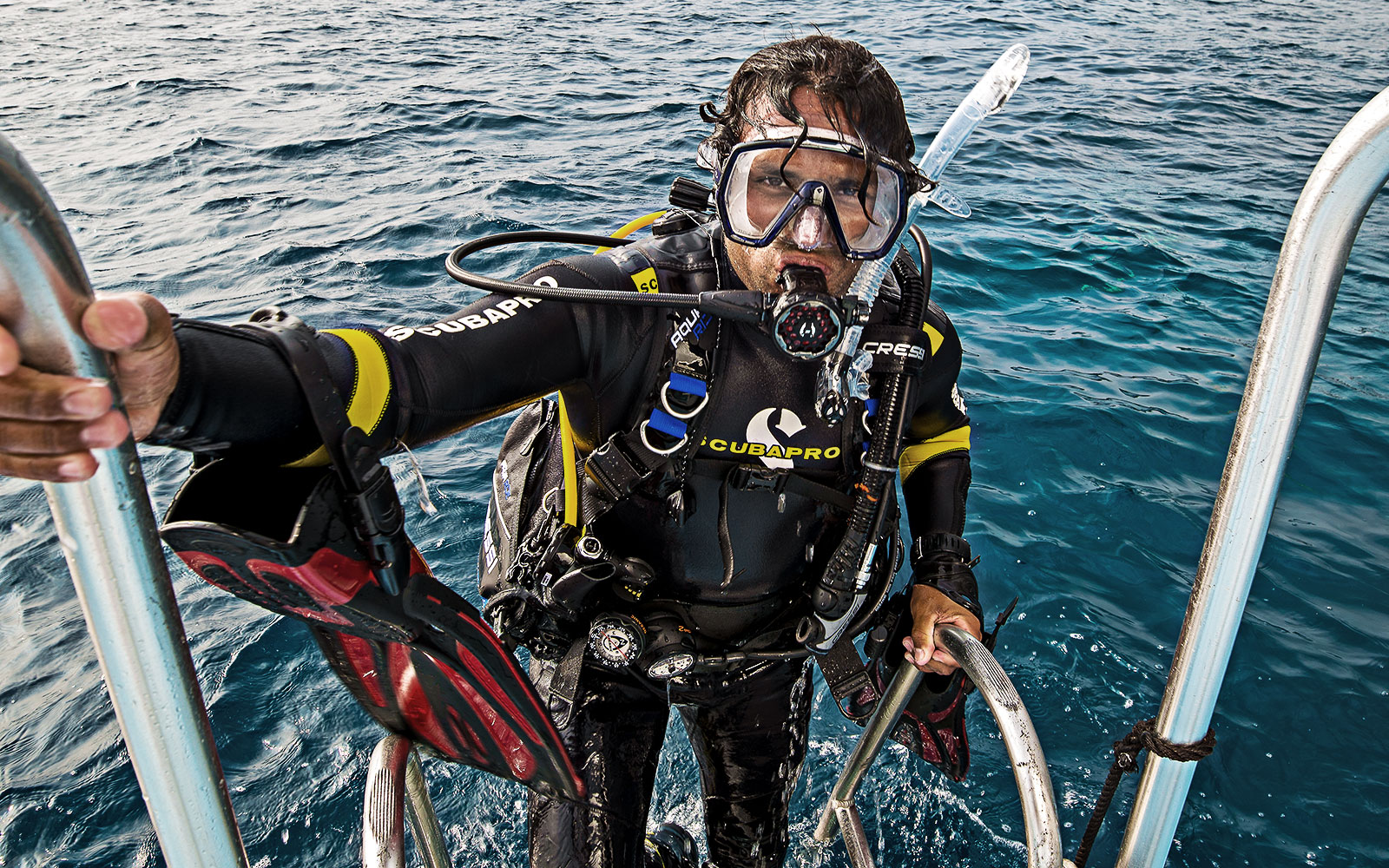
So now that you’ve dipped your toes into the world of scuba diving, it’s time to figure out what gear you’ll need. Throughout this article, I will list what gear you need, what gear you should both buy and rent, and what you can expect to spend on these items!
Gear You Need
*The prices listed below are suggestions for what you should expect to spend on new gear. Keep in mind that you can often find good, used equipment for much cheaper. Those with higher budgets can spend much more on high-end gear; however, you can find solid gear within all of the price ranges listed below.
-Scuba Tank: will carry all of the air you need for your dive.
Should Rent
-BCD: Buoyancy compensator device. This is the vest you’ll be wearing which secures your scuba tank on your back and allows for you to establish your buoyancy underwater. It’s one of the most important pieces of dive gear as an uncomfortable BCD can mean the difference between an amazing or terrible dive.
Should Rent; Cost to Purchase: $200-500
-Weights for BCD: help you with establishing buoyancy. Without proper weight, you may not even be able to get underwater.
Should Rent/ Buy Used
-Scuba Regulator Package: should include your main regulator, your octo (your backup regulator for either yourself or your dive buddy), your scuba gauge (tells you how much air is in your tank, your depth, and typically has a compass), and your inflator hose (pumps air from the scuba tank into your BCD which helps you either float or sink).
Cost: $250-600
–Wetsuit (Depending on your location): for some locations such as Florida for example, you may not even need a wetsuit. A wetsuit is your own preference. For colder regions, you will need a wetsuit. For warmer regions, you may be just fine without one. Experiment and find out what works best for you.
Cost: $50-150
–Scuba Mask: everyone needs a good mask. The most annoying thing you can experience while diving is an uncomfortable mask, one that doesn’t find you right, or one that constantly leaks.
Cost: $20-80
–Snorkel: much more handy than you would think. A snorkel is very helpful when you are swimming on the surface as it allows you to keep your focus below you as you’re swimming. It’s also very handy when you’re on the surface because it will keep you from wasting much needed air from your scuba tank. Spend a few bucks, get a snorkel, and attach it to your mask. Don’t go on a dive without one.
Cost: $10-30
–Fins: for comfortability reasons, you’ll need good fins. Having good fins can be the cherry on top of an amazing dive. If you have fins that don’t fit you or are uncomfortable, you’re likely to be thinking about them for the entirety of your dive. Get fins that fit you well. If you go through a whole dive and forget about your fins, chances are you picked the right ones.
Cost: $35-95
-Boots: scuba fins are not like normally swimming fins. Normal swimming fins allow you to put your foot directly in the fin. For scuba fins, you have to have scuba boots to fit into your fins properly. You can find comfortable scuba boots for quite cheap too. My personal pair of scuba boots were purchased for $10, and they’re often my favorite part of my scuba gear.
Cost: $20-40
Total: 585-1495
*If you shop for used gear, you’re likely to get even better prices than the ones listed above
Gear You Should Buy
Keep in mind, if you only plan to dive several times, there’s no need to buy your own dive gear. However, if you’re hooked on diving and plan on diving many times, purchasing your own dive gear will benefit you both emotionally and financially for years to come.
Not only can buying gear save you money in the long run, it can help to ease your mind knowing that all your gear has been used properly. Not to mention, who doesn’t just like having their own dive gear?! Anyways, here the list of things you should consider buying:
–Wetsuit (Depending on your location): when you’re starting out, it may be helpful to rent different wetsuits to find out which one fits you best, is most comfortable, and aids in your buoyancy underwater. Once you’ve found one that you like best, buy it! Wetsuits aren’t all that expensive, so you should use your money to buy one rather than continually renting one. You may not even need to rent any if you’ve got a local dive shop that will let you try on and test their wetsuits.
–Scuba Mask: you shouldn’t have to rent goggles. Just go into a dive shop and try on goggles that fit you well. Also, don’t let the price fool you. Masks don’t have to be expensive to work well. Find the one that fits you well. For advice on how your mask should fit, try this site.
–Snorkel: an inexpensive piece of dive gear. For how cheap you can find these, it really makes no sense to rent one.
–Fins: you can also find these relatively cheap. There are very expensive models out there, but you can certainly find a pair that fits your needs for cheap. For reference, I found a pair of scuba fins that worked for me for $20 at a garage sale.
–Boots: again, you must have boots for your scuba fins. For the cheap price of most boots, it makes no sense to rent them when you can buy them to pair with your fins. Make sure they fit both your foot and the fin well.
Gear You Should Rent
–BCD: for starting out, you should rent your BCD. There are many different BCDs out there, but once you find one you like, it’s might be to your advantage to go ahead and purchase it. When renting your BCD, make sure they supply you with weight. If not, make sure to also rent weights.
-Scuba Regulator Package: find a regulator that works well for you. It should be comfortable in your mouth, supply you with good air flow, and shouldn’t mess up your mask seal. Once you’ve found one that fits these criteria, look into purchasing the reg setup complete with your main regulator, octo, scuba gauge, and inflator hose.
–BCD Weights: lugging around BCD weights can get tiring. Not to mention, just for a single, small weight, it can cost anywhere from $10-30. Most dive shops only charge you a few bucks to rent them, and some dive shops even give them to you for free when you rent a BCD. This one is really up to you. If you can find cheap used weights, buy them. If you can’t or it’s too much hassle, just stick to renting them.
-Scuba Tank: this is the one item that I would recommend always renting. The reason for this is that whether you have your own tank or not, you have to go to a dive shop to get your tank refilled. Having your own tank, you’ll also be responsible for inspections of your tank to make sure it’s up to date and fit for use. Not to mention, if you plan on flying somewhere for a dive trip, your dive tank would be a huge hassle because of it’s size and weight. For these reasons, it’s often around the same price with less hassle to just rent tanks rather than buy your own.
As you start to dive more, you should be able to take some of these items off of the rent list and put them on your buy list. The reason I suggest renting these things first is because these are items you should test out during your dives.
By renting these items, you should be able to find gear that fits your preferences and fits you comfortably. Once you find gear that you like, look into buying it. Renting gear can be expensive and after just several dives, the price that you paid to rent equipment could have likely paid for one or more of those items.
 Diving Deeper
This is very insightful information! Thank you for an honest opinion about renting vs buying. I agree that some equipment should be used on a trial basis before an actual purchase. This might help someone to avoid an expensive mistake. Kudos!
LikeLike
It’s my pleasure! When it comes to actual renting vs. buying, everyone has their own preferences and recommendations. This is simply my honest advice on the matter, so I’m happy to hear you gained some insight!
LikeLike